This year 43 feature documentaries will be screened in
Park City, Utah, theaters, and Blackfish will be one of them. The movie was
selected from a field of over 2000 entries.
Many of these films will go around the world and some will earn theatrical releases. As described by Ondi Timmoner at TheLipTVthis, "Is the key curation moment for many filmmakers."
The topic of the film will partly examine the tragic life of the captive orca named "Tilikum," which means "friend," and "shows the sometimes devastating consequences of keeping such intelligent and sentient creatures in captivity."
None of us at VOTO have seen the film, or know much about it. But we do know that footage was collected on land and sea from sites all over the world and over the past two years. Good luck to Gabriela and her film #Blackfish. Meet "Gabby" below...
Have you ever read the actual Marine Mammal Protection Act (MMPA) of the United States? At Voice of the Orcas, we hadn't, until now. We focused on the part that deals with placing cetaceans into captivity, which begins on page 20, "Regulations on (the) taking of Marine Mammals." Understanding what the MMPA says is useful because the #SeaCircus industry is an entertainment one, and is not fulfilling the spirit of the MMPA which suggests conservation, education and wild animal research. There was no research going on at SeaWorld on behalf of wild populations, or on the fisheries they depend on, when we were there. The big push was to try and figure out artificial insemination methods so they could boost the captive population. After all, the show must go on. The photos help make our point. [It's interesting to note that SeaWorld is partially responsible for the MMPA because of how the company decimated the Southern Resident orca population here: Rounding up Shamu with Don Goldsberry]
This looks similar to the Miami Dolphins football LOGO. The team just partnered up with SeaWorld for a marketing deal
Below, you'll find the legislation, as passed by the United States Congress in 1972, and as amended in 2007. But keep scrolling past that for our illustrated guide. Remember, we're reprinting the MMPA's first page below, unaltered. The only thing we added were the images.
We believe that many of today's marine parks are in violation of this law. If not from a technical or legal standpoint, surely from the standpoint of being in violation of the spirit of the law.
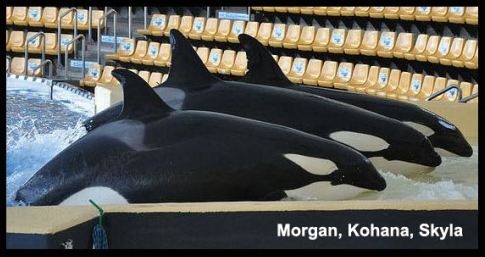
Morgan has been abducted by the #SeaCircus Industry because she is worth millions. If she becomes pregnant SeaWorld owns her baby and she will never be released. This is how SeaWorld is getting around the MMPA
To make this point clear, we've juxtaposed the opening page of the MMPA with photographs of the ridiculous stunts that the #SeaCircus industry is using to entertain the public. As you look at the images, try to imagine what type of learning it provides. Remember, the agreement to keep cetaceans captive is based upon the promise of education. And, to make matters worse, when places like SeaWorld claim they "educate" the public, such as during shows for school children, they provide false information. Here at VOTO, we know this as fact, because, sadly, we did it ourselves, back in the 1990's.
Orca captivity will end if SeaWorld stops breeding animals in captivity. We urge the industry to use contraception to prevent future pregnancies. This poor guy, Taku, died young and impregnated his own mother, producing Nalani
Things like orca longevity are skewed downward so SeaWorld can better explain why their orcas die young, on average. They tout teeth irrigation(s) as "superior dental care." But they don't mention that the animals are breaking their teeth because of captivity. And they describe the frozen-thawed smelt, herring, and salmon as "restaurant quality," when in reality, its not. There is no such label on that fish. And they fail to mention that the freezing-thawing process removes precious fresh-water (fluids) from the dead fish which leads to dehydration in captive cetaceans. This is why Tilikum's diet is supplemented with 10 gallons of gelatin daily (roughly 80 U.S. pounds or 36.28 Kilograms). Like us, cetaceans can't drink saltwater, so they rely on their food to get fresh water.
These images are in the public domain, and some of them are shocking. Feel free to download these and post on Twitter. We have a brief conclusion at the end...
(1) certain species and population stocks of marine mammals are, or may be, in danger of extinction or depletion as a result of man' s activities;
How does balancing on the rostrum of a captive orca justify taking Katina, Morgan, Corky, Tilikum, & Lolita from nature?
(2) such species and population stocks should not be permitted to diminish beyond the point at which they cease to be a significant functioning element in the ecosystem of which they are a part, and, consistent with this major objective, they should not be permitted to diminish below their optimum sustainable population. Further measures should be immediately taken to replenish any species or population stock which has already diminished below that population. In particular, efforts should be made to protect essential habitats, including the rookeries, mating grounds, and areas of similar significance for each species of marine mammal from the adverse effect of man' s actions;
This looks like a "Dance Gone Wrong" with Tilikum. But regardless, it has little educational value. Poor Tilikum, where are his TEETH?
(3) there is inadequate knowledge of the ecology and population dynamics of such marine mammals and of the factors which bear upon their ability to reproduce themselves successfully;
When the graceful & shy belugas are dressed as circus clowns, it makes the GA Aquarium's request for 18 wild ones hard to swallow
(4) negotiations should be undertaken immediately to encourage the development of international arrangements for research on, and conservation of, all marine mammals;
(5) marine mammals and marine mammal products either— (A) move in interstate commerce, or
(B) affect the balance of marine ecosystems in a manner which is important to other animals and animal products which move in interstate commerce, and that the protection and conservation of marine mammals and their habitats is therefore necessary to insure the continuing availability of those products which move in interstate commerce; and
The MMPA doesn't apply to Japanese killers at The Cove, but the demand for small cetaceans is created by the Display Industry (SeaWorld, Ga AQ, Miami SQ) #CaptivityKills Photo from SeaShepherd Conservation Society used with Permission
(6) marine mammals have proven themselves to be resources of great international significance, esthetic and recreational as well as economic, and it is the sense of the Congress that they should be protected and encouraged to develop to the greatest extent feasible commensurate with sound policies of resource management and that the primary objective of their management should be to maintain the health and stability of the marine ecosystem. Whenever consistent with this primary objective, it should be the goal to obtain an optimum sustainable population keeping in mind the carrying capacity of the habitat.
This is an advertisement for SeaWorld's night show. Where's the educational part? This is a #SeaCircus designed to entertain customers, NOT educate our children
From Page 22 of the MMPA (2)(A) A permit may be issued to take or import a marine mammal for the purpose of public display only to a person which the Secretary determines— (i) offers a program for education or conservation purposes that is based on professionally recognized standards of the public display community
---------------------------------
COMMENT: And there's the loophole, highlighted above. What that last part, in yellow, basically does is allow for the "public display community" to develop it's own standards. And therein lies the problem.
The answer to this is:
1. Science
2. Organization / social media
3. Educating the public
4. Getting involved with government
5. Electing progressive leaders
Thanks to all of you who are reading this now and spreading the good word. We're on the right side of history.
--------------------- ORIGINAL ARTICLE BELOW --------------------
If you're disillusioned with the political environment in the United States... join the club. Frankly, and sadly, as Ice Cube & Tom Morello recently put it, "Everythang's Corrupt." [note: The video is hardcore]
That said, there is a clear choice this election, and we at Voice of the Orcas believe the Obama-Biden Administration is more suited to deal with issues like climate change and oceanacidification; things that directly impact humans, whales, and all life on Earth. This is reflected, already, in the President's investment in clean-energy renewable resources such as wind and solar. See how many wind turbines have been added to this Central Washington landscape since our President was elected in 2008:
It's worth pointing out that the GOP and it's voters are pro-deregulation. For them, it's all about providing a business climate that does one thing:
Make Money for Corporations
We have no problem with businesses making profits, but only if it's done responsibly. Often times, the de-regulators get rid of policies and rules that protect animals and nature. Incredulously, the GOP hasn't officially recognized that climate change is happening. It's this deregulation & tweaking of the Marine Mammal Protection Act that has gutted oversight of places like SeaWorld, the Miami SeaQuarium, & various marine zoos, and catalyzed the explosive development of these dolphin swim-with programs in places like Las Vegas and the Florida Keys. This translates into more dead dolphins & pilot whales at The Cove.
We don't believe there is educational value to this. Unfortunately, two of these orca,Taku & Kalina, died young, at 14 & 25, respectively. Taku from West Nile Virus, and Kalina from bacteria in her blood
This is wrong. NOAA & APHIS should be more empowered to protect marine mammals, not less.
(Only time will tell if the Georgia Aquarium & SeaWorld will successfully import 18 Russian caught belugas).
We believe that an Obama Administration is more likely to enforce regulations that are already on the books, and will interpret legislation like the Marine Mammal Protection Act more favorably than a pro-Romney, (more) pro-corporation, administration. We also believe that an Obama Administration is more likely to uphold the recent findings of the OSHA v SeaWorld hearings, in Sanford, Florida. SeaWorld has appealed this ruling, and a Romney appointed Secretary of Labor is more likely to "roll back" OSHA's findings, and his orders. Back in June, Federal Judge Ken S. Welsch stated:
"SeaWorld's own incident reports demonstrate that its safety program, either due to misplaced faith in operant conditioning or due to human error in implementing operant conditioning, exposes its trainers to the risks of death or serious physical injury."
This is embarrassing. The justification for keeping cetaceans, like Lolita, in captivity, is that the place educates. What are we teaching our children by endorsing this type of activity? Poor Lolita.
It's also interesting to note that theses places promote, endorse, and give the majority of their campaign dollars to GOP candidates, and less for conservation:
These dollars are provided to mostly Republican candidates because they often lead to benefits for the companies, including loosening the rules associated with cetacean captivity. Despite record profits in 2011, SeaWorld paid no Federal Income Tax this year. Read that story here:
Loosening regulations on the #SeaCircus has created a demand for more cetaceans. The end result is that Russian and Japanese collectors are experiencing large financial incentives to trap and even kill cetaceans, as is happening in The Cove, right now. To quote a member of the Russian Academy of Sciences, Dmitri Glasov:
On 29 October 2012, Andy Heil (@Andy_Heil), an editor at RadioFreeEurope, in Prague, called Jeffrey Ventre, a former SeaWorld trainer from 1987-1995. "JV" had worked with belugas at SeaWorld's Orlando park for 3.5 years in the 1990's, and now works as a physician in the United States.
Along with his Voice of the Orcascolleagues, Carol, Samantha, & John Jett PhD , JV now speaks out in opposition to captivity for cetaceans, which swim kilometers each day, in the ocean, and live in very close-knit nuclear families. Dr Jett (JJ) says,
I love when places like SeaWorld use the catch-all justification that the… “whales are needed to help with their captive breeding programs, research, and education.” Yes, indeed, they do need to extend their captive breeding program so that they can continue to profit from a population housed [essentially] in concrete bathtubs. You also have to love the “research” justification. The peer-reviewed scientific literature is conspicuous in its absence of research articles based on captive belugas (and orcas) in places like SW. I worked as a trainer at SW in the 1990s; no real science occurred with the captive orcas which were in my care. None.
Hashtag #CaptivityKills
@Voice_ot_Orcas
@Sam10k
@Jeffrey_Ventre
And belugas, like other cetaceans, do poorly in captivity. For example, all of the belugas that Carol, Samantha, and Jeffrey worked with at SeaWorld are dead, as are their offspring; which is precisely why the U.S. marine park (#SeaCircus) industry needs more.
This particular phone call from Andy to JV was for a radio segment (that has since aired) for Russia and (the country of) Georgia. Andy had just completed an article on the U.S. Georgia Aquarium's controversial attempt to import 18 wild caught beluga whales that would be distributed to SeaWorld parks, and to the Shedd & Mystic Aquariums. This was a follow up to that article, which can be read in The Atlantic, here:
The most unique thing regarding the broadcast piece (transcribed below) is that it includes commentary from a Russian expert, Dmitry Glazov, who makes some astounding claims.
Mr. Glazov is a beluga whale "specialist" at the Russian Academy of Sciences who says belugas "adapt well" and "can play" in captivity. He also states that they live 1.5 times as long in captivity as they do in the wild. This is, as far as we know, an unsubstantiated claim that is not supported in the professional scientific literature. Most disturbing is his affirmation that China is "requesting a lot of these animals." Please, read on: -------------------------- UNEDITED RADIO TRANSCRIPT ------------------------ Russian Whales Caught Up In U.S. Debate On Ethics Of Captivity
(AUDIO available under NC102921 & NC102511 & NC102904 & NC102922/23)
(INTRO) A request by some of the United States' biggest oceanariums to import 18 beluga whales from Russia has set off a stormy public debate over the legality and ethics of wild-animal captures for science and entertainment. If they're transferred, the animals would become the first marine mammals (eds: includes seals and sea lions, whales and dolphins, walruses, etc.) caught in the wild and put on display in the United States in nearly two decades (sin ce 1993). But opponents are determined not to let that happen. RFE/RL's Andy Heil and Tom Balmforth have more.
MOSCOW/PRAGUE, October 29, 2012 (RFE/RL) --
(INSERT AUDIO -- Beluga whale -- :10 -- NC102921)
Sailors for centuries have dubbed them "canaries of the sea" for their chirps and warbles. One bioacoustic scientist famously noted that they sounded "reminiscent of a string orchestra tuning up."
Belugas, or white whales, are also among the first cetaceans (eds: whales or dolphins) to have been brought into captivity -- in part because of their striking white appearance and engaging personalities but also because keepers say they're quick to adapt and train.
That impression was reinforced last week with the emergence of audio recordings of a beluga named "Noc" (say: Nok) -- without prompting -- seemingly mimicking human voices:
Noc was recorded during research in California in the 1980s, when scientists say they subsequently taught him to "speak" on cue.
But their capture or import has been illegal in U.S. waters since the passage 40 years ago this month (October 1972) of the U.S. Marine Mammal Protection Act (or MMPA). That legislation has helped many species of whale and other marine mammal to rebound from centuries of slaughter.
Now, the Georgia Aquarium (in Atlanta) and four oceanarium partners want an exception. They have plans to import 18 belugas for a captive-breeding project that they say will educate and inspire the public while helping to ensure "the survival of belugas everywhere."
What has followed since their application was filed in June is a bruising war of words and principles, with public comments kept open an extra 30 days (until October 29) because of intense interest in the case.
Critics insist that even Georgia Aquarium's 32,000 cubic meters of water isn't enough for healthy, highly intelligent sea mammals born to travel tens of kilometers a day in the open ocean.
Jeffrey Ventre, a former whale trainer at the SeaWorld marine park in Orlando, Florida, is among the applicants' staunchest critics: (INSERT AUDIO -- Ventre in English -- length :50 -- NC102904) "I think it's dangerous, number one because it provides a profit motive for these trappers in Russia to continue collecting these animals for the black market or for the open market, which is what it would become. I think once you open the floodgates (eds: allow something to begin), so to speak, what's going to prevent them from going out and collecting killer whales, which have a higher market value than beluga whales? I just think it sets a dangerous precedent. I think it goes against the spirit of the [U.S.] Marine Mammals Protection Act, and that's why it hasn't happened since 1993. And the fact that these belugas need to be replaced is an indicator that the system didn't work to keep them alive in captivity ... [as] these marine circuses claim. So I think there are just a lot of reasons why it shouldn't happen."
Defenders -- including scientists commissioned by the applicants -- say the loss of 18 animals poses no risk to an Arctic and sub-Arctic beluga population of around 150,000 animals.
But it would represent a huge jump in the North American captive-beluga population, currently between 31 and around 40, depending on the source.
It's also just a drop in the ocean compared with the quota of 1,060 belugas set by Russian authorities for 2012 alone to provide food for indigenous minorities (Chukchi), scientific research, or entertainment.
The Russian beluga program has been accused by animal rights and ecological groups of recklessly catching all sorts of wild marine mammals to become a leader in a booming international trade.
It's a charge that is disputed by Dmitry Glazov, a beluga whale specialist at the Russian Academy of Sciences' Institute for Ecology and Evolution Problems who's also one of six members of a national fisheries board that sets quotas on catches.
He says Soviet-era and subsequent studies indicate the population in the Sea of Okhotsk from which these whales were snatched is "growing."
Moreover, having worked with whales in and out of the wild, he insists captive belugas aren't so unfortunate:
(INSERT AUDIO -- Glazov in Russian -- length 1:18 -- NC102922) "I can't report that the animals are unhappy in captivity. They adapt well and are able to play. They live there longer than in the wild -- I've studied it [and] they live about 1 1/2 to two times longer. Moreover, if it's done well, there is a huge plus in that people who find themselves among nature and, say, throw things in the sea -- these people, by interacting with these animals, come to understand what these creatures are. They realize that they are not pictures on TV or something abstract, but intelligent, beautiful, sociable and interesting animals that need to be looked after. It is difficult for people to understand this any other way."
That answer might anger opponents of captivity of highly developed animals like dolphins and belugas. But Glazov suggests the pressure to catch more wild belugas is growing and won't go away anytime soon:
(BEGIN OPTIONAL TRIM)
(INSERT AUDIO -- Glazov in Russian -- length 1:16 -- NC102923) "Over probably the last three years, since China is developing quickly and they are building oceanariums, they are requesting lots of these animals. In Russia, as strange as it sounds, there is quite high domestic demand for this animal, too. That's why the number of commercial organizations that want to catch them and apply for permission to do so has gone up. And [on] the Sea of Okhotsk's Tchkal Island -- where the only team that is able to catch them is based -- they used to catch 20 animals per year for transport or sale. Now they apply to catch 40 to 50 animals. However, in principle, for the time being, the weather, boats and so on don't allow them to catch more than 25 to 30 animals."
(END OPTIONAL TRIM)
The U.S. fisheries agency is expected to issue its decision on Georgia Aquarium's request early next year.
In the meantime, the eight male and 10 female belugas at the heart of the application -- some of whom have been languishing in Russian facilities on the Black Sea for as long as six years -- will continue to wait.
Reprinted with Permission. Original document embedded below. Sea Life Boss Weighs In To Try And Save Captured Whales The UK-based Sea Life Centre network has thrown its weight behind efforts to block the export of 18 beluga whales from Russia to aquariums in the US. The 18 ‘white’ whales were taken from the wild by Russian trappers and are now in cramped holding pens awaiting their fate. The Georgia Aquarium in Atlanta has applied for a federal import permit on behalf of a group of marine parks, saying the aquariums need the Arctic whales for captive breeding efforts, research and education. But Sea Life’s US Divisional Director in New York, Janine DiGioaccino, has written a strong letter of protest to the US Government.
Writing on behalf of the 41 Sea Life centres worldwide, including five in the US, Janine said that Sea Life concurred with the view of all the leading authorities in this field and indeed the majority of ordinary American citizens canvassed on the subject, that cetaceans are not suited to captivity…no matter how spacious or well-designed the facilities. Belugas SeaLife Center Statement
“They are wide-ranging, highly intelligent and social animals which suffer acute sensory deprivation in any kind of unnatural confinement,” she added.
“The argument that such displays are good for education and conservation does not, in our view, come anywhere near to outweighing the undoubted suffering and stress incurred not only by the captured animals themselves, but also by the family groups from which they have been so cruelly and abruptly separated.” She went on to criticise the US for being among the ‘worst offenders’ in perpetuating an out-dated and wholly unethical trade and practice. “Keeping cetaceans of any kind, unless they are injured or ailing rescued animals requiring full time care, is just plain wrong,” she added. “We would be failing in our responsibility as the world’s largest aquarium operator were we not to say so publicly, for the long-term credibility of our industry as well as the more immediate benefit of the unfortunate beluga whales currently awaiting their fate in Russia.” The Sea Life network’s global headquarters is in Poole, Dorset, and it has a long-term partnership with the charity Whale & Dolphin Conservation. Opponents of Georgia Aquarium’s plans have until Monday, October 29th, to register their protest via the website: http://www.regulations.gov/#!documentDetail;D=NOAA-NMFS-2012-0158-0001 Issued by Merlin Entertainments (Sea Life) Ltd. For more details contact: Mark Oakley 01202 440040.
-----------------------
The full text of Janine’s letter is copied below:
October 25th, 2012 To Whom It May Concern… On behalf of SEA LIFE Centres worldwide, not least the five centres here in the US, I feel compelled to register the strongest possible opposition to the proposed import of the 18 wild-caught belugas to the Georgia aquarium. SEA LIFE concurs with the view of all the leading authorities in this field and indeed the majority of ordinary American citizens canvassed on this subject, that cetaceans are not suited to captivity…no matter how spacious or well-designed the facilities. They are wide-ranging, highly intelligent and social animals which suffer acute sensory deprivation in any kind of unnatural confinement. The argument that such displays are good for education and conservation does not, in our view, come anywhere near to outweighing the undoubted suffering and stress incurred not only by the captured animals themselves, but also by the family groups from which they have been so cruelly and abruptly separated. America is an enlightened nation which should be leading the world in demonstrating care and compassion for special creatures like these. Instead we are one of the worst offenders in perpetuating an out-dated and wholly unethical trade and practice. SEA LIFE’s parent company has itself – through its acquisition of theme parks which already housed them - become costodian of captive dolphins and whales. Rather than further exploit these animals for profit, we are urgently progressing plans to create a natural sanctuary where these and hopefully others from other public attractions around the world, can be re-homed, retired and if feasible, rehabilitated. Keeping cetaceans of any kind, even when there is some educational merit, is a vastly different proposition to the display of fish and other marine creatures which have been proven to flourish is carefully designed and maintained aquarium tanks. Unless they are injured or ailing rescued animals requiring full time care, it is just plain wrong…and we would be failing in our responsibility as the world’s largest aquarium operator were we not to say so publicly, for the long-term credibility of our industry as well as the more immediate benefit of the unfortunate beluga whales currently awaiting their fate in a cramped holding pen in Russia. Janine DiGioacchino Divisional Director Merlin Entertainments (Midway) USA
From The Cove, in Taiji, where braveSeaShepherd Cove Guardians are live streaming the annual dolphin slaughter, to a new short film from the Pacific Northwest, to the U.S. Government's Beluga importation hearings in Silver Spring, Maryland, October of 2012 has proven to be a productive one for the rapidly growing group of concerned humans, in all countries, who oppose the confinement and slaughter of whales and dolphins for profit. The anti-captivity community is leveraging the power of technology and social media to spread the word that >>click<< #CaptivityKillscetaceans, usually at a young age. Unfortunately, despite these efforts and shifting public opinion, countries such as India, China, Russia, Dubai and others are ramping up efforts to collect and display whales and dolphins that are forced to perform tricks for food, often from within deplorable facilities, and certainly nothing that can match the freedom of the sea. This captivity expansion is escalating demand for the brutal practice of extracting whales & dolphins from the ocean and from their families. It's keeping places like The Cove, in Taiji, as busy as ever. One day captivity will be a thing of the past. Until then, education is the key.
In the first of two videos we'd like for you to view & share, the Humane Society's marine mammal scientist Dr. Naomi Rose, author David Kirby of Death at SeaWorld, and three former SeaWorld trainers, all part of Voice of the Orcas, visit Puget Sound and observe resident orcas, to compare their lives with those of captive orcas. Learn how places like SeaWorld & the Georgia Aquarium use the guise of "education" to justify their need for wild caught animals.
In our second (and exclusive) video, former SeaWorld trainer Samantha Berg provides some solid facts and intel regarding the recent NOAA hearings in Silver Spring, Maryland. Samantha traveled from Palmer, Alaska, to testify. This was the first time, historically, that a former SeaWorld trainer spoke against the industry and against captivity in such a forum. So, it was a novel experience and she has a lot to say about it in the video below. But first, Journalist Brandon Keim, at Wired Online, described the situation like this:
Controversy is brewing over the Georgia Aquarium’s plan to import 18 beluga whales captured off the coast of Russia. If the U.S. government approves the plan, it will mark the first time in nearly two decades that wild-caught cetaceans have been imported into an aquarium in the United States.
According to the aquarium, the whales are needed for research and education. According to animal welfare advocates, that doesn’t justify the trauma inflicted on intelligent, emotional creatures that suffer in captivity.
From the NOAA Fisheries Website, here is where these 18 wild caught belugas will spend the rest of their lives, pending approval:
Please watch this interview of VOTO's Samantha Berg, who testified at the hearings in Silver Springs, Maryland, USA, on Friday 12 October 2012. This interview was filmed Sunday 14 October 2012 in Seattle, WA, USA, and Sam is being interviewed by Ellensburg, WA, resident, Karen Bicchieri. You can follow Sam via Twitter @Sam10k